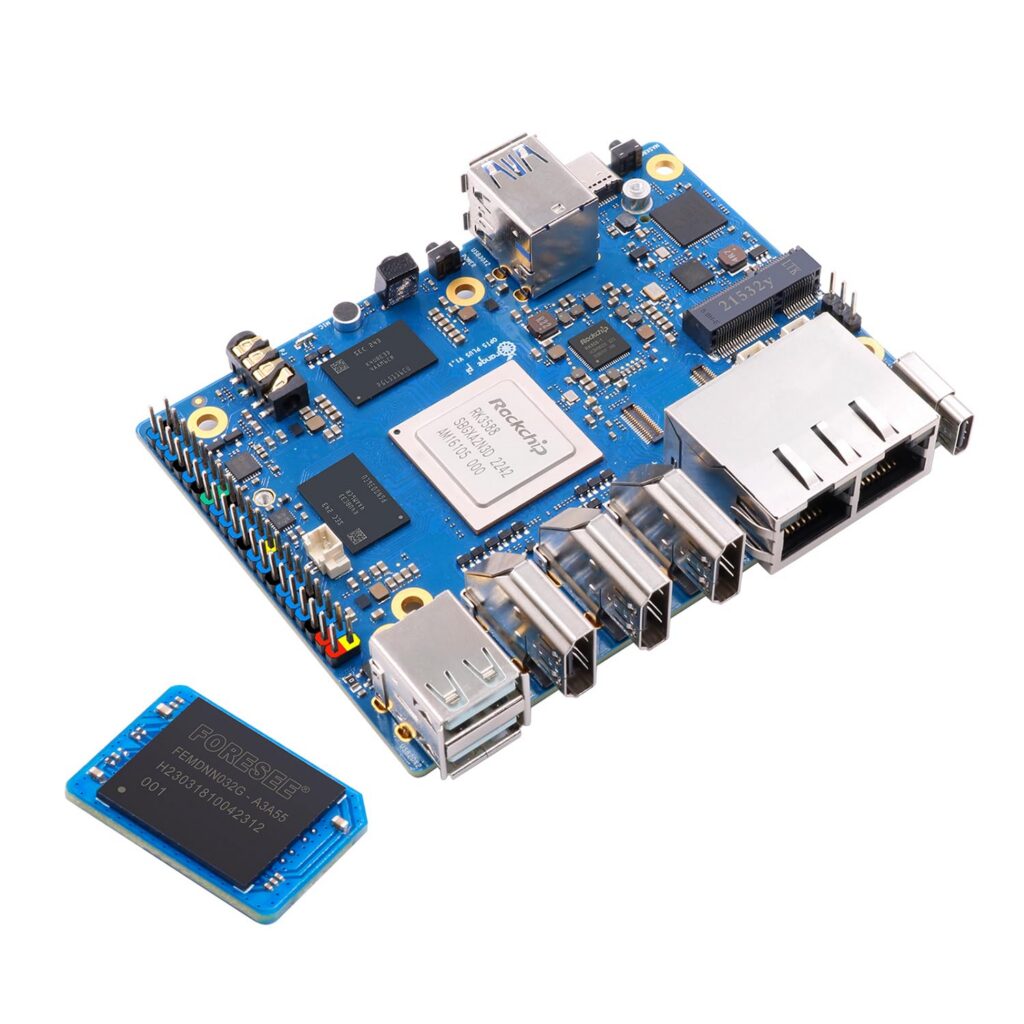
The single-board computer market has needed a true Raspberry Pi alternative for years – one that offers comparable ease of use but with more horsepower. The Orange Pi 5 Plus might just be that board. With specs that dwarf the Raspberry Pi 5 and a price tag that undercuts comparable x86 systems, this compact computer deserves serious consideration from makers, hobbyists, and even professionals.
Unboxing and First Impressions
Right out of the box, the Orange Pi 5 Plus makes an impression:
- The board has a premium feel with its matte black PCB and gold-plated ports
- An abundance of connectivity options immediately stands out
- The layout is logical, though slightly more crowded than a Raspberry Pi
- Included documentation is minimal – typical for these types of boards
What you won’t find in the box that you might expect:
- No heatsink or fan (essential for sustained performance)
- No power supply (requires USB-C PD)
- No storage (no microSD card included)
Technical Specifications That Matter
Let’s break down what makes this board special:
Processing Power:
- Rockchip RK3588 SoC with 8 cores (4x Cortex-A76 @ 2.4GHz + 4x Cortex-A55 @ 1.8GHz)
- ARM Mali-G610 MP4 GPU with support for modern APIs
- Neural Processing Unit capable of 6 TOPS for AI workloads
Memory and Storage:
- LPDDR4X RAM options from 4GB up to 16GB
- NVMe SSD support via PCIe 3.0 x4 slot
- eMMC module support (optional)
- Standard microSD card slot
Connectivity Highlights:
- Dual 2.5Gbps Ethernet ports (a rarity at this price point)
- USB 3.0 and USB 2.0 ports
- USB-C with DisplayPort alternate mode
- M.2 slot for adding Wi-Fi 6/Bluetooth
Video Capabilities:
- Dual HDMI 2.1 outputs supporting 8K@60Hz
- HDMI 2.0 input (4K@60Hz) for video capture
- MIPI DSI display interface
Real-World Performance Testing
After weeks of testing across various workloads, here’s how the Orange Pi 5 Plus performs:
General Computing:
- Noticeably faster than Raspberry Pi 5 in daily tasks
- Handles web browsing with multiple tabs smoothly
- Office applications run without lag
Media Performance:
- 4K video playback is flawless
- 8K playback works but can be demanding on some codecs
- HDMI input works well for video capture applications
Gaming:
- Emulates up to PlayStation 2/GameCube well
- Native Linux games run respectably at 1080p
- Vulkan support opens up more gaming possibilities
Server Applications:
- Dual 2.5G Ethernet makes it excellent for network applications
- NVMe support provides storage performance unseen in most SBCs
- Handles multiple Docker containers with ease
Software Ecosystem and Compatibility
This is where things get interesting – and where potential buyers should pay close attention.
Supported Operating Systems:
- Orange Pi OS (based on Arch Linux and Android)
- Ubuntu and Debian variants
- Armbian (recommended for stability)
- Android 12
The Good:
- Mainline Linux kernel support is improving
- Most basic peripherals work out of the box
- Active community support forums
The Challenges:
- Some hardware acceleration features aren’t fully optimized
- Occasional driver quirks, especially with newer kernels
- Not all GPIO functions are as polished as Raspberry Pi’s
Thermals and Power Consumption
Thermal Performance:
- Requires active cooling for sustained workloads
- With a good heatsink and fan, stays under 70°C even at full load
- Passive cooling only works for light tasks
Power Efficiency:
- Idles around 5W
- Peaks around 15W under heavy load
- More efficient than comparable x86 solutions
Use Cases Where the Orange Pi 5 Plus Excels
After extensive testing, these are the scenarios where this board truly shines:
1. High-Performance Home Server
- NAS functionality with NVMe storage
- Media server with hardware transcoding
- Network firewall/router with dual 2.5G ports
2. Desktop Replacement
- Capable office workstation
- Media playback center
- Light gaming system
3. Development Platform
- ARM software development
- AI/ML experimentation
- Edge computing applications
4. Retro Gaming System
- Emulates consoles up to PS2/GameCube
- Supports modern game controllers
- Handles shaders well for retro aesthetics
Comparison to the Competition
How does it stack up against other popular SBCs?
Vs Raspberry Pi 5:
- Significantly more CPU power
- Far better I/O options
- Less polished software experience
- Higher power consumption
Vs Rock 5B:
- Similar core specs
- Better Ethernet configuration
- More affordable pricing
- Comparable software support
Vs x86 Mini PCs:
- More power efficient
- Better suited for ARM-native workloads
- Lacks Windows support
- More limited in some professional applications
Who Should Buy the Orange Pi 5 Plus?
Ideal For:
- Tech enthusiasts wanting maximum SBC performance
- Homelab users needing compact power
- Developers working on ARM software
- Media center enthusiasts
- Network appliance builders
Not Ideal For:
- Absolute beginners to single-board computers
- Those needing plug-and-play simplicity
- Users dependent on Raspberry Pi-specific accessories
- Applications requiring certified reliability
Final Verdict: A New High Water Mark for ARM SBCs
The Orange Pi 5 Plus represents a significant leap forward for single-board computers. While it doesn’t quite match the Raspberry Pi’s polish and ecosystem, it offers substantially more performance and flexibility for power users.
The Bottom Line:
✅ Buy if you need high-end ARM performance and can handle some Linux configuration
❌ Avoid if you want absolute simplicity or need Raspberry Pi compatibility
Priced competitively against both other SBCs and low-end x86 systems, the Orange Pi 5 Plus carves out an interesting niche. For those willing to work within its limitations, it offers a glimpse at the future of affordable, high-performance computing.
Have you used the Orange Pi 5 Plus? Share your experiences and tips in the comments below!